Tuesday, April 7, 2020

Testimonies Rock! The virtual version...

Testimonies are such a powerful tool.... useful beyond the framework of Quakerism as a faith.


Quaker testimonies are commonly recognized by Friends and Quaker Schools alike as the core values inherent in leading a right life. They are often referred to as SPICES as a handy way to remember them: simplicity, peace, integrity, community, equality, and stewardship.

Be thoughtful, however, there is a risk in getting too comfortable 
with this memory device. By using SPICES, we sometimes 
limit the field of potential growth. 
Testimonies are not limited to those 6 - those 6 are the starting point!


From the Sidwell Friends School archives


Consider your friendships...


How do you tend to your friendships? Do you work at them? Compromise? Apologize? Show love? Feel respect? 

How do you begin a new friendship?


All of these ideas are testimonies. We might call them personal testimonies. If the six above are the Quaker testimonies that we work on as a community, then these personal testimonies are those tailored exactly to each individual's needs - personal testimonies.

If you look at the trees and flowers above again more carefully, you might notice some of those testimonies on the small flowers. What do you notice? What would you add? What do you wonder?

Spend some time thinking about what you might need to work on - maybe around building friendships, maybe around reflection, maybe around taking action. What is an area that you need to work on and grow in order to live a kinder, friendlier life? 


Write or draw your thinking. Make a list, find the one or two ideas that are really popping out for you.Draw your own testimony tree. Print this one out. Build a tree from found materials.


Create testimony rocks. Print these and cut them out. Create some rocks out of found materials. Find some actual rocks and paint them.


Add some Quaker testimony rocks around the base of your tree. These are the starting point. 


Add some leaves. Print these and cut them out. Create some leave out of found materials. Find some actual leaves and write on them.

These might be your personal testimonies. These might be family testimonies or classroom testimonies.


What is your personal testimony? Should it be a rock or a leaf? What makes you think so?


Post your testimony tree someplace that you'll see it. The most important part of this is the reflecting on and planning about how you will live your personal testimony.

Check in with yourself about how you're doing... Are you holding your testimonies in your "pocket"? What steps are you taking to work on these testimonies? Are they working? How do you know?


For added information about testimonies:

https://quakered.blogspot.com/2020/03/testimonies-rock-course-for-personal.html

Types of thinking encouraged: 

  • Encourage Inquiry
  • Slow Looking
  • Practice Articulation
  • Develop Questions
  • Make it Safe
  • Introduce a Topic or Object


Wednesday, April 1, 2020

Artful Reflections


An interesting scene... before you set your ideas about what might be happening here, follow this path:

Look carefully. Slowly.
Look at the corners, the top, the bottom, the middle.
What do you notice? What items or beings do you see? 
Don't think yet about what might be happening, just notice what you see.

What does this scene remind you of?
What do you think of as you look at this painting?

What about this painting might feel unexpected?
What surprises you about this scene?

What do yo think is happening in this painting?
What questions do you have?
What do you wonder?

Take some time to reflect on these questions in writing or using art or by video recording. 

Don't rush. 
Let some silence fall between your ideas and keep looking carefully.


This painting is called Peaceable Kingdom.

It was painted by Edward Hicks.

This version lives at the National Gallery of Art in Washington, DC. You can visit it here.


Hicks was renowned as a minister - he had a much respected ability to share aloud the inner light rising from his silent reflection.

For Hicks, painting was an extra - preaching was his passion, what he believed he was born to do. He painted Peaceable Kingdom more than 62 times! Rumor says that you can see signs of his own state of mind, at the time of each version, in the facial expressions of his animals.


George Fox, founder of Quakerism wrote:
“Be patterns, be examples in all countries, places, islands, nations wherever you come; that your carriage and life may preach among all sorts of people, and to them; then you will come to walk cheerfully over the world, answering that of God in everyone; whereby in them you may be a blessing, and make the witness of God in them to bless you.” Statement of 1656, from The Works of George Fox (1831)

George Fox is getting at the idea of Letting Your Life Speak here.


How is Edward Hicks letting his life speak in this artistic work? 

How will you let your life speak?


Feel free to share your visible thinking with me at coffind@sidwell.edu. I will add them to this post. If you wish, include documentation (photos, video, writing) of your process.

For added information about testimonies:

https://www.nga.gov/collection/art-object-page.59908.html
https://www.nga.gov/collection/artist-info.1396.html
https://www.britannica.com/biography/Edward-Hicks


Types of thinking encouraged: 

  • Develop Questions
  • Connect to Prior Knowledge
  • Slow Looking
  • Practice Articulation
  • Safe Exploration of a Topic, Idea, or Object
  • Wonder about Differences or Similarities

Source:
A twist on the See Think Wonder thinking routine: https://www.smore.com/emm0s-see-familiar-surprise-wonder


Tuesday, March 24, 2020

Exploring Testimonies

This week I've been thinking about how we might examine our interactions and our actions through the lens of Quaker testimonies. 

It's still the time to consider how testimonies can be personal guideposts as we try to live a right life. Today, more than ever, our Quaker identity calls us to act, reflect, love, learn. Dr. Martin Luther King, Jr. asked us to build the beloved community - one of justice, peace, love. Margaret Fell asked "What canst thou say?"- not necessarily a literal question, a reminder to listen to others, to the earth, to our own inner teacher. It was a call to act. It was a call to love.

We have explored the Quaker and personal testimonies through the course Testimonies Rock! You can read more about our interactive course by clicking here.

Let's take this opportunity to look carefully at the Quaker testimonies of
truth, community, equity, and fairness. 

Begin by taking some time to think about each of these. You might write each testimony in the center of a piece of paper. Around the word on the center of the page, jot down your thinking - don't edit yourself, just write what comes to mind as you think about each of these testimonies.

You might ask:
What comes to mind when I think about truth? 
What do I feel makes up the idea of _____? Why is ____ important? 
How do I define ____? 

Once you've done this for each of the four testimonies, take a few moments to reflect on your visible thinking. What are the main ideas for each that seem to be popping out? Circle those ideas. Are there any common threads between all four? Where are the differences?

Take some time to capture (through writing, drawing/painting, recording, dictating) these big ideas.

Which of these testimonies feels the most relevant at this time for you? Using your chosen testimony, create a reflection and an intention:


The testimony of ________ is important/resonates now more than ever.


  • What do you see, feel, know, believe that makes your claim true for you? Consider all the ways that you have defined this testimony. Ask yourself "what makes me say that?"
  • What's left unanswered or unknown? What isn't explained? What new questions or issues does this claim raise?
  • How does this draw me to act? What part do I play in this?
https://www.quaker.org.uk/blog/lets-explore-the-quaker-way

For added information about testimonies:


Types of thinking encouraged: 

  • Develop Questions
  • Explore in Depth
  • Examine Differing Points of View
  • Begin to develop sensitivity to big ideas
  • Deepen emerging understandings about global questions/challenges
  • Develop thoughtful interpretations by encouraging reasoning with evidence
  • Identify truth claims
  • Explore strategies for uncovering truth

Source:


Sunday, March 15, 2020

A Query for Remote/Crisis Learning

This week we will begin distance learning as a school community.

We believe that it is more important than ever that we hold onto core elements of our Quaker identity.

We must continue to think about how we might let our lives speak and our lights shine during a confusing, unsteady, and often scary time.

Regardless of circumstance, we are still called to reflection and action. What might that look like for our young learners as we embark on new and strange times of social distancing, online learning, lack of face to face connection?

We will begin with a Query.

Consider the big idea of your individual responsibility to the community.

  • Why does the role of the individual matter? 
  • How does each person's actions affect the immediate community? Why does that matter? 
  • How might this affect the goings on in our world?

Reflect using art, writing, making, playing...

What query or queries might serve our community as we proceed?


Holding you all in the light.


For added information about queries:


Types of thinking encouraged: 


  • Develop Questions
  • Explore in Depth
  • Construct Narratives
  • Examine Differing Points of View
  • Begin to develop sensitivity to big ideas
  • Deepen emerging understandings about global questions/challenges

Source:
https://www.smore.com/4zycy-the-3-y-s-thinking-routine


Monday, March 9, 2020

Testimonies Rock! A course for personal growth

This is a wonderful article describing an interactive course around using testimonies to teach character development and growth.


https://www.sidwell.edu/about/news/news-detail/~board/homepage-news-panel/post/using-weighted-words-to-find-a-personal-testimony

Come join us for Testimonies Rock!


*Note: We credit Jessica Beels' installation of Weigh Your Words with inspiring this course. After Kathleen and I experienced this powerful art exhibit, we were drawn to the idea of creating an interactive experience with the Quaker Testimonies and something of the earth - seashells, rocks, branches... We eventually found that rocks were the best suited for our course. You can read more about Beels' exhibit here: http://www.jbeelsdesign.com/blog/?p=160


Text of article from Sidwell Friends School Website:

Using Weighted Words to Find a Personal Testimony

MARCH 10, 2020
Using Weighted Words to Find a Personal Testimony
“I think testimonies are one of the big tentpoles of Quakerism at a Quaker school,” Coffin said. “It’s listening to that still, small voice and looking at how you travel through this world constantly making yourself and the world a better place. As a Quaker school, there are no better tools than testimonies to teach reflection, making good choices, personal identity, and growth.”


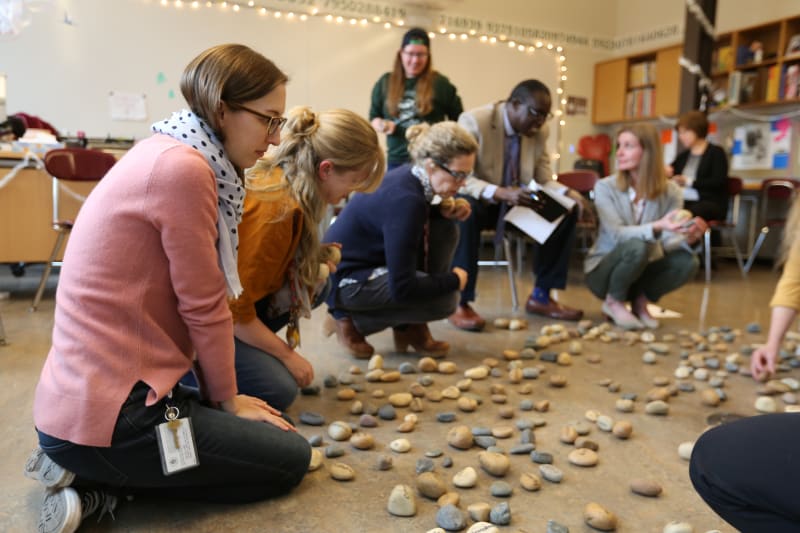
Denise Coffin enters the pre-K classroom a little slowly. After all, she’s weighted down—literally. She’s pushing a dolly with three milk crates full of rocks in front of her.
“I’m getting ready to add another cart of rocks,” she said. “I want there to be even more rocks.”

Coffin isn’t a geology teacher; she teaches kindergarten. The rocks are part of a course—“Testimonies Rock!”—that she and preK teacher Kathleen Geier developed to open up a discussion about the concept of personal testimonies. Together, they’ve guided multiple grades of Lower School students, as well as faculty and staff, through the course over the past four years.
“A testimony is what’s either lacking in me that I have to work on, or something calling to me that I want to make stronger,” Geier said. “It comes from the inside out; you’re moved by how you should be and then the words are given to those actions.”

Geier and Coffin used the work of Paul Buckley from the Earlham School of Religion to boil down the concept of a personal testimony into five basic points: (1) a personal testimony is a calling, not a choosing; (2) it is a public act; (3) it is reflective of the shared values of a community; (4) it requires effort; and (5) it is an expression of love. The rocks, therefore, have words like “respect” and “service” written on them. If a child cannot find a word that speaks to them on the prepared rocks, Geier and Coffin have blank rocks for students to write their own words on.

“The rocks have different weights; they’re solid and they’re sturdy, and they’re part of the Earth,” Coffin said. “They’ve been around forever, a lot like our testimonies.”
The physical weight of the rocks also imparts an important lesson: Quantity does not equal quality.

“Sometimes they’re balancing them or they’re trying to hold as many as they can in their hands, which tells you something about how many testimonies you should really be working on at the same time,” Coffin says. “There’s such a thing as too many at once.”

In addition to a tactile experience, the rocks are also interactive—sometimes in surprising ways.
The teachers assigned the words to the rocks arbitrarily, but the children found meaning in these details. For example, Coffin said that a student might think the reason “fairness” is on a big rock and “kindness” and “community” are on small rocks is that “kindness” and “community” build up to “fairness.” Coffin found this exciting: “That wasn’t part of the design, but because of the physicality of it, it’s helping them think of a testimony in very different ways than we even anticipated.” 

The course begins with students arriving at their individual testimonies, but then they expand the idea to the larger community.
“We think about something we’re working on personally, and then we talk about it as a class,” Coffin said. She asks the students for ideas of testimonies that make sense to them and then asks them to figure out a way to apply the idea to the whole class.

There’s also something to be learned when students notice the rocks that they’re not attracted to.
“Sometimes the mission is to look for the ones that are pushing you away, that are almost repelling you,” Coffin said. “The ones where you’re think, ‘Oh, that is really uncomfortable for me. I can’t look at ‘patience.’”
Geier added that noticing those awkward rocks allows the children “to just wonder why.” Then they can say to themselves, “That’s telling me something about the work I need to do with patience.”
As Coffin and Geier developed the class, they learned as well.


At first, Geier said, she worried that some groups might not understand the exercise and become silly. “That’s just never happened,” she said. “I’ve learned to trust the silence and the exploration and them moving into the rocks without very much guidance.”


Wednesday, October 23, 2019

Conversation about Quakerism: Truth

This month we continued our yearlong series of conversations around Quakerism. We plan to gather each month for a conversation inspired by a topic connecting to our Quaker identity. Our conversations will be sparked by selected publications, videos, social media posts, news reports, etc.

We framed our conversation with the Quaker idea and testimony of Truth. We considered what Truth might mean in the context of teaching and learning in a Friends school using these resources:


Friends of What? (Quaker Historical Lexicon)


https://quakerlexicon.wordpress.com/tag/friends-of-truth/


Guided by an Inner Truth (QuakerSpeak, Sterling Dunn, 04/16/2015)
https://quakerspeak.com/guided-inner-truth/


Truth is Something that Happens (Quaker Earthcare Witness, Louis Cox)
https://www.quakerearthcare.org/article/truth-something-happens


Vital Friends: What Bayard Rustin's Life and Activism Can Teach Us About Finding Common Ground by Marta Rusek Friends General Council, 4/30/19

https://www.fgcquaker.org/news/vital-friends-what-bayard-rustins-life-and-activism-can-teach-us-about-finding-common-ground

https://www.afsc.org/story/bayard-rustin


Our conversation was loosely structured using the following prompts:
  • What questions does this raise for you?
  • What insights have you discovered?
  • What concerns does this raise for you?


Our reflections inspired some queries...

We are all listening to our own truth... How might that create and enrich our community? How might that cause divisions? How do we understand who has which part of the truth?

Where is the gray in not knowing the truth? Where is the joy in not knowing the truth?

Prison reform really resonates to some of us in the work we do. What role does truth play in our criminal justice system? How can we make this system better?

How do we listen for the truth?

If we agree that there is not just one truth, that everyone has a piece of the truth, that humility is an important part of truth, then how do we teach that to our children? How do we help them understand that no one has all the answers?

How do we model humility? (and trying out new ideas, growing, changing)

How do we approach building trust and breaking trust in our teaching and learning context?

Friday, October 4, 2019

Query for Parents this month...


For our gathering of parents this month, our clerks have created a query to guide the conversation. These queries will be shared with parents as they explore how they and their families interact with technology and screens.


In an increasingly digital age, how can we guide our children to make good choices about the use of technology and screen time?


How do we, as parents and teachers, join in this – modeling, learning, making choices, etc… What do our actions “teach” about what we value when it comes to technology/screens?

A Kindergarten Query for the beginning of the school year

Query writing: We took on a large job in kindergarten and wrote the first Query of the school year.   A query is a Quaker kind of a questio...