Showing posts with label distance learning. Show all posts

Friday, February 12, 2021

Lunar New Year - Interfaith Education

Photo by Maud Beauregard on Unsplash

We are in the midst of the Lunar New Year!

At my school, we have had all manner of learning, sharing, and celebrating.

My hope for my students is that they learn to approach every new opportunity with curiosity and openness. Rather than notice differences or ideas of shock or strangeness, imagine holding space for wonder! 

As a way to encourage this approach, I have created an extended thinking routine of sorts. It is our interfaith dialog and education thinking routine. We use this routine throughout the year with each new observance or tradition, each new opportunity for interfaith exploration and wonder. Teachers are free to adapt, simplify, or chunk the thinking moves in the routine in any way that makes sense for their learners. Our hope is that teachers will settle on a version that they can use again and again, making this interfaith routine, routine.

We often begin with a story. It may be a story that is read by a member of the community or the teacher. It may be a story that a member of our community shares from their own personal history or identity.

You might use this story Bringing in the New Year by Grace Lin

:

Grace Lin

Exploring the Lunar New Year, a thinking routine:


As you reflect upon the Lunar New Year story…


What is important to know about the Lunar New Year?

What feels familiar?

What surprises you? What is unexpected?


Further thinking about a point of view and the connectedness to our Quaker identity/the faith or non-faith based elements of our community’s identity:


Whose perspectives are being represented? How do you know? 

Whose perspective might be missing? 

In what ways might this connect to Quaker ideas or practices?

In what ways might this connect to your own story?


Further thinking about the relevance of all of this in the larger community or in our world:


Why might hearing these stories or learning about these traditions be important?

What role do these ideas play in our families? In our community? In our world? (Why might learning about this be important?)


Always great questions to ask:

What connections can you make?

What do you wonder?


How does the idea of light connect to the Lunar New Year? To our Quaker identity? To each of us?


What do you do with this thinking routine? Some options...

  • use the queries to guide a conversation
  • write about your thinking in response to the queries
  • paint or draw or create an artful representation in response to these queries (painted reflection journals)
  • use a query as a chalk talk prompt


Want to learn more?


This interfaith thinking routine is adapted from the See Familiar Surprise Wonder routine.

Wednesday, February 3, 2021

Testimony Tulips

In our never-ending search for ways to bring Quakerism into our classroom practices, we've got a new and simple way to visually think about testimonies!

Testimony Tulips...
In this lesson, we'll create a tulip that we'll use to explore and reflect on our personal or Quaker testimonies.

Can you draw your tulip?

What are the testimonies that you wish to explore?

How might your tulip change over time?

You might want to dive a little deeper into what a testimony by clicking here. 


Types of thinking encouraged: 

  • Develop Questions
  • Explore in Depth
  • Examine Differing Points of View
  • Begin to develop sensitivity to big ideas
  • Deepen emerging understandings about global questions/challenges


Friday, January 15, 2021

Honoring the Light and Life of Dr. Martin Luther King, Jr.

 Some of Dr. Martin Luther King Jr's less familiar speeches that hold significance still today:


The Atlantic - The King Issue

Martin Luther King Jr. on the Vietnam War


editor's note: 
King’s opposition to the Vietnam War gained national attention on February 25, 1967, when he appeared alongside four anti-war U.S. senators at a daylong symposium in Beverly Hills, California. In a powerful address, King described how the casualties of the increasingly unpopular war had spread beyond its physical horrors to wreck the Great Society and threaten American principles and values. His outspokenness about an issue not ordinarily seen as a question of civil rights brought a storm of criticism.


Above is King's speech honoring the Preliminary Emancipation Proclamation ahead of its 100th anniversary in 1962 (this footage was rediscovered in 2013). 


Video details:  "On September 12, 1962, Dr. Martin Luther King, Jr. gave a speech at the Park Sheraton Hotel in New York City to honor the Preliminary Emancipation Proclamation on the eve of its centennial anniversary."


Letter from a Birmingham Jail

from the King Institute at Stanford University:


Read and listen here.


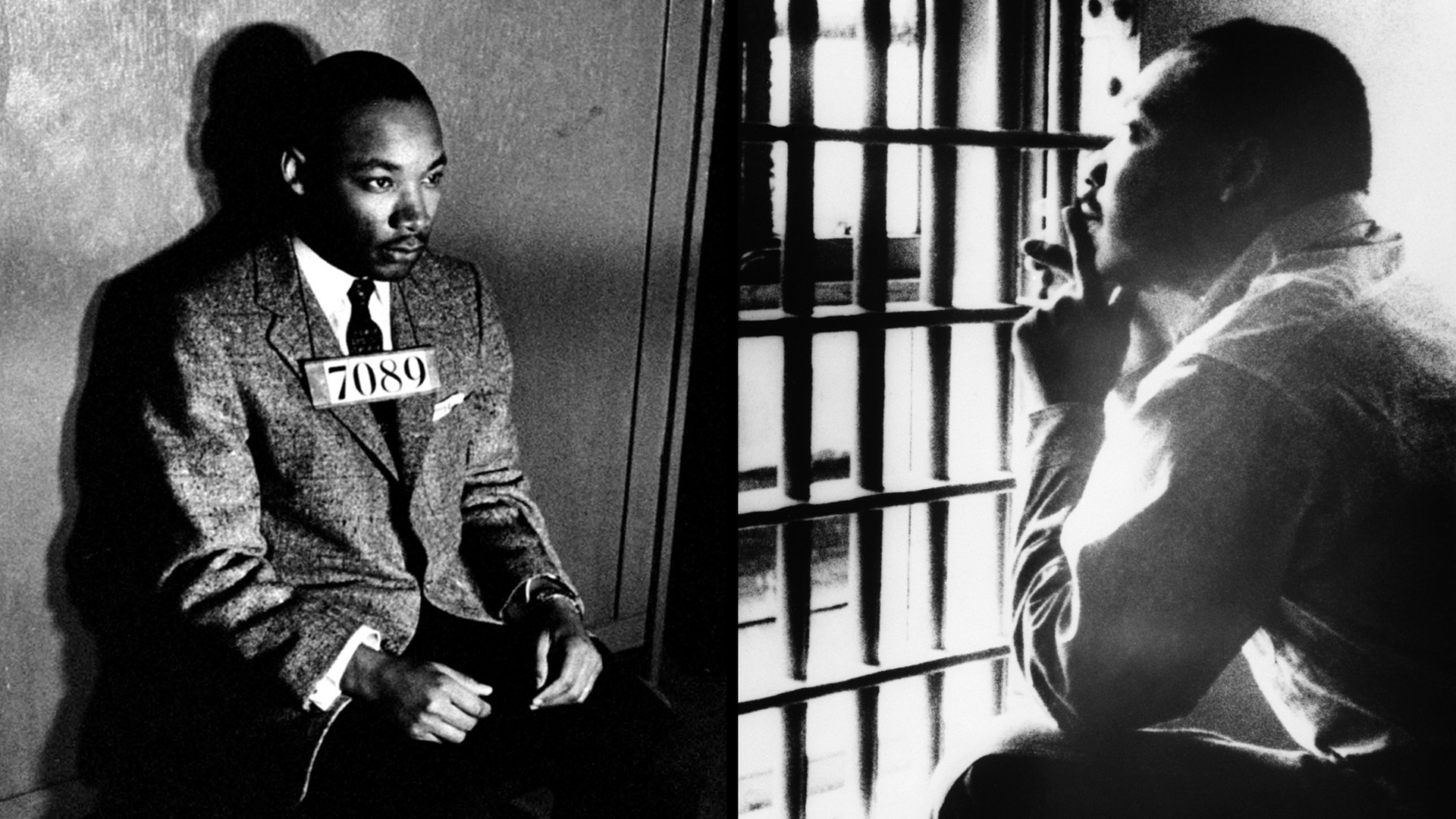
Image is shared via The Atlantic - King Issue: "King is ready for a mug shot (left) in Montgomery, Alabama, after his 1956 arrest while protesting the segregation of the city's buses. His leadership of the successful 381-day bus boycott brought him to national attention. Right: In 1967, King serves out the sentence from his arrest four years earlier in Birmingham, Alabama."


You might wish to share these resources with a protocol or thinking routine for reflection.


Some possibilities:

See/Familiar/Surprise/Wonder

See 
What do you see or notice? 
Find the Familiar 
What about this feels familiar? What resonates?
Find the Surprise 
What about this feels surprising or unexpected?
Wonder 
What questions do you have? What do you wonder?

About this Routine: 
Use this routine to practice perspective taking and looking at things, ideas, images from a global viewpoint.

  • Encourage Inquiry
  • Slow Looking
  • Practice Articulation
  • Develop Questions
  • Make it Safe
  • Introduce a Topic or Object
  • Wonder about differences and similarities
  • Examine Differing Points of View


The 3 Ys

Present learners with an issue, image, or problem that has large scale implications. Ask learners to consider the following questions:

  • Why might this (idea, topic, question) matter to me?
  • Why might it matter to the people around me (community, friends, family, city, nation)?
  • Why might it matter to the world?
Types of thinking encouraged: 

  • Slow Looking
  • Develop Questions
  • Explore in Depth
  • Construct Narratives
  • Examine Differing Points of View
  • Begin to develop sensitivity to big ideas
  • Deepen emerging understandings about global questions/challenges


Wednesday, December 16, 2020

Meeting for Worship - Practicing Stillness

We have been challenged this year to find ways to share Meeting for Worship and other Quaker practices in a variety of ways of doing school: in person, at home, and everything in between. We have begun to document these practices for teachers, students, and other members of our community.


In this lesson, we'll learn how and why we settle or center ourselves.


How can we settle our whole selves for our community Meeting for Worship?

How can I use settling and centering outside of Meeting for Worship?


You might share this video with students and then ask them to spend some time reflecting on when it might be helpful to practice stillness.When might centering ourselves, stilling our bodies, and quieting our sounds be a handy tool?

Remember that there are many ways to worship and to be reflective. Students may practice a faith or non-faith tradition that connects with our Quaker identity along a spectrum. Find ways to celebrate and highlight those connections. Approach differences with curiosity, kindness, and openness.

Types of thinking encouraged: 

  • Develop Questions
  • Connect to Prior Knowledge
  • Practice Articulation
  • Safe Exploration of a Topic, Idea, or Object
  • Wonder about Differences or Similarities
  • Build an understanding around identity

Wednesday, November 18, 2020

Meeting for Worship at a Quaker School

We have been challenged this year to find ways to share Meeting for Worship and other Quaker practices in a variety of in person school, at home learning, and all versions in between. We have begun to document these practices for teachers, students, and other members of our community.

In this lesson, we'll set up our space.

Where will you have Meeting for Worship?

What will your Center Table look like?


You might share this video with students and then ask them to spend some time reflecting on what items might belong on their center table. Why do those selected items matter to them? How will they help them during their worship?

Remember that there are many ways to worship and to be reflective. Students may practice a faith or non-faith tradition that connects with our Quaker identity along a spectrum. Find ways to celebrate and highlight those connections. Approach differences with curiosity, kindness, and openness.

Types of thinking encouraged: 

  • Develop Questions
  • Connect to Prior Knowledge
  • Practice Articulation
  • Safe Exploration of a Topic, Idea, or Object
  • Wonder about Differences or Similarities
  • Build an understanding around identity


Friday, May 8, 2020

Build a Testimony Tree: Remote Classrooms * Connected Learning

This week we began sharing brief video invitations for our young students. These invitations are provocations to continue to grow around ideas and elements of our Quaker identity.


Today, we begin by building a Testimony Tree.


This invitation involves ideas around found items, natural materials, art, making, and printing. Students are invited to choose a media in which to create a tree for the purpose of exploring, documenting, and reflecting on Quaker and personal testimonies.


Tuesday, April 7, 2020

Testimonies Rock! The virtual version...

Testimonies are such a powerful tool.... useful beyond the framework of Quakerism as a faith.


Quaker testimonies are commonly recognized by Friends and Quaker Schools alike as the core values inherent in leading a right life. They are often referred to as SPICES as a handy way to remember them: simplicity, peace, integrity, community, equality, and stewardship.

Be thoughtful, however, there is a risk in getting too comfortable 
with this memory device. By using SPICES, we sometimes 
limit the field of potential growth. 
Testimonies are not limited to those 6 - those 6 are the starting point!


From the Sidwell Friends School archives


Consider your friendships...


How do you tend to your friendships? Do you work at them? Compromise? Apologize? Show love? Feel respect? 

How do you begin a new friendship?


All of these ideas are testimonies. We might call them personal testimonies. If the six above are the Quaker testimonies that we work on as a community, then these personal testimonies are those tailored exactly to each individual's needs - personal testimonies.

If you look at the trees and flowers above again more carefully, you might notice some of those testimonies on the small flowers. What do you notice? What would you add? What do you wonder?

Spend some time thinking about what you might need to work on - maybe around building friendships, maybe around reflection, maybe around taking action. What is an area that you need to work on and grow in order to live a kinder, friendlier life? 


Write or draw your thinking. Make a list, find the one or two ideas that are really popping out for you.Draw your own testimony tree. Print this one out. Build a tree from found materials.


Create testimony rocks. Print these and cut them out. Create some rocks out of found materials. Find some actual rocks and paint them.


Add some Quaker testimony rocks around the base of your tree. These are the starting point. 


Add some leaves. Print these and cut them out. Create some leave out of found materials. Find some actual leaves and write on them.

These might be your personal testimonies. These might be family testimonies or classroom testimonies.


What is your personal testimony? Should it be a rock or a leaf? What makes you think so?


Post your testimony tree someplace that you'll see it. The most important part of this is the reflecting on and planning about how you will live your personal testimony.

Check in with yourself about how you're doing... Are you holding your testimonies in your "pocket"? What steps are you taking to work on these testimonies? Are they working? How do you know?


For added information about testimonies:

https://quakered.blogspot.com/2020/03/testimonies-rock-course-for-personal.html

Types of thinking encouraged: 

  • Encourage Inquiry
  • Slow Looking
  • Practice Articulation
  • Develop Questions
  • Make it Safe
  • Introduce a Topic or Object


Wednesday, April 1, 2020

Artful Reflections


An interesting scene... before you set your ideas about what might be happening here, follow this path:

Look carefully. Slowly.
Look at the corners, the top, the bottom, the middle.
What do you notice? What items or beings do you see? 
Don't think yet about what might be happening, just notice what you see.

What does this scene remind you of?
What do you think of as you look at this painting?

What about this painting might feel unexpected?
What surprises you about this scene?

What do yo think is happening in this painting?
What questions do you have?
What do you wonder?

Take some time to reflect on these questions in writing or using art or by video recording. 

Don't rush. 
Let some silence fall between your ideas and keep looking carefully.


This painting is called Peaceable Kingdom.

It was painted by Edward Hicks.

This version lives at the National Gallery of Art in Washington, DC. You can visit it here.


Hicks was renowned as a minister - he had a much respected ability to share aloud the inner light rising from his silent reflection.

For Hicks, painting was an extra - preaching was his passion, what he believed he was born to do. He painted Peaceable Kingdom more than 62 times! Rumor says that you can see signs of his own state of mind, at the time of each version, in the facial expressions of his animals.


George Fox, founder of Quakerism wrote:
“Be patterns, be examples in all countries, places, islands, nations wherever you come; that your carriage and life may preach among all sorts of people, and to them; then you will come to walk cheerfully over the world, answering that of God in everyone; whereby in them you may be a blessing, and make the witness of God in them to bless you.” Statement of 1656, from The Works of George Fox (1831)

George Fox is getting at the idea of Letting Your Life Speak here.


How is Edward Hicks letting his life speak in this artistic work? 

How will you let your life speak?


Feel free to share your visible thinking with me at coffind@sidwell.edu. I will add them to this post. If you wish, include documentation (photos, video, writing) of your process.

For added information about testimonies:

https://www.nga.gov/collection/art-object-page.59908.html
https://www.nga.gov/collection/artist-info.1396.html
https://www.britannica.com/biography/Edward-Hicks


Types of thinking encouraged: 

  • Develop Questions
  • Connect to Prior Knowledge
  • Slow Looking
  • Practice Articulation
  • Safe Exploration of a Topic, Idea, or Object
  • Wonder about Differences or Similarities

Source:
A twist on the See Think Wonder thinking routine: https://www.smore.com/emm0s-see-familiar-surprise-wonder


Tuesday, March 24, 2020

Exploring Testimonies

This week I've been thinking about how we might examine our interactions and our actions through the lens of Quaker testimonies. 

It's still the time to consider how testimonies can be personal guideposts as we try to live a right life. Today, more than ever, our Quaker identity calls us to act, reflect, love, learn. Dr. Martin Luther King, Jr. asked us to build the beloved community - one of justice, peace, love. Margaret Fell asked "What canst thou say?"- not necessarily a literal question, a reminder to listen to others, to the earth, to our own inner teacher. It was a call to act. It was a call to love.

We have explored the Quaker and personal testimonies through the course Testimonies Rock! You can read more about our interactive course by clicking here.

Let's take this opportunity to look carefully at the Quaker testimonies of
truth, community, equity, and fairness. 

Begin by taking some time to think about each of these. You might write each testimony in the center of a piece of paper. Around the word on the center of the page, jot down your thinking - don't edit yourself, just write what comes to mind as you think about each of these testimonies.

You might ask:
What comes to mind when I think about truth? 
What do I feel makes up the idea of _____? Why is ____ important? 
How do I define ____? 

Once you've done this for each of the four testimonies, take a few moments to reflect on your visible thinking. What are the main ideas for each that seem to be popping out? Circle those ideas. Are there any common threads between all four? Where are the differences?

Take some time to capture (through writing, drawing/painting, recording, dictating) these big ideas.

Which of these testimonies feels the most relevant at this time for you? Using your chosen testimony, create a reflection and an intention:


The testimony of ________ is important/resonates now more than ever.


  • What do you see, feel, know, believe that makes your claim true for you? Consider all the ways that you have defined this testimony. Ask yourself "what makes me say that?"
  • What's left unanswered or unknown? What isn't explained? What new questions or issues does this claim raise?
  • How does this draw me to act? What part do I play in this?
https://www.quaker.org.uk/blog/lets-explore-the-quaker-way

For added information about testimonies:


Types of thinking encouraged: 

  • Develop Questions
  • Explore in Depth
  • Examine Differing Points of View
  • Begin to develop sensitivity to big ideas
  • Deepen emerging understandings about global questions/challenges
  • Develop thoughtful interpretations by encouraging reasoning with evidence
  • Identify truth claims
  • Explore strategies for uncovering truth

Source:


A Kindergarten Query for the beginning of the school year

Query writing: We took on a large job in kindergarten and wrote the first Query of the school year.   A query is a Quaker kind of a questio...