Showing posts with label Committee. Show all posts

Friday, February 12, 2021

Lunar New Year - Interfaith Education

Photo by Maud Beauregard on Unsplash

We are in the midst of the Lunar New Year!

At my school, we have had all manner of learning, sharing, and celebrating.

My hope for my students is that they learn to approach every new opportunity with curiosity and openness. Rather than notice differences or ideas of shock or strangeness, imagine holding space for wonder! 

As a way to encourage this approach, I have created an extended thinking routine of sorts. It is our interfaith dialog and education thinking routine. We use this routine throughout the year with each new observance or tradition, each new opportunity for interfaith exploration and wonder. Teachers are free to adapt, simplify, or chunk the thinking moves in the routine in any way that makes sense for their learners. Our hope is that teachers will settle on a version that they can use again and again, making this interfaith routine, routine.

We often begin with a story. It may be a story that is read by a member of the community or the teacher. It may be a story that a member of our community shares from their own personal history or identity.

You might use this story Bringing in the New Year by Grace Lin

:

Grace Lin

Exploring the Lunar New Year, a thinking routine:


As you reflect upon the Lunar New Year story…


What is important to know about the Lunar New Year?

What feels familiar?

What surprises you? What is unexpected?


Further thinking about a point of view and the connectedness to our Quaker identity/the faith or non-faith based elements of our community’s identity:


Whose perspectives are being represented? How do you know? 

Whose perspective might be missing? 

In what ways might this connect to Quaker ideas or practices?

In what ways might this connect to your own story?


Further thinking about the relevance of all of this in the larger community or in our world:


Why might hearing these stories or learning about these traditions be important?

What role do these ideas play in our families? In our community? In our world? (Why might learning about this be important?)


Always great questions to ask:

What connections can you make?

What do you wonder?


How does the idea of light connect to the Lunar New Year? To our Quaker identity? To each of us?


What do you do with this thinking routine? Some options...

  • use the queries to guide a conversation
  • write about your thinking in response to the queries
  • paint or draw or create an artful representation in response to these queries (painted reflection journals)
  • use a query as a chalk talk prompt


Want to learn more?


This interfaith thinking routine is adapted from the See Familiar Surprise Wonder routine.

Sunday, November 29, 2020

Speaking into the Silence

This post includes a lesson we prepared for our students about Meeting for Worship and why or how people might speak into the silence.


How can I listen to my still small voice?

What messages are coming to mind?

Are they messages that create or invite growth?


Monday, March 9, 2020

Testimonies Rock! A course for personal growth

This is a wonderful article describing an interactive course around using testimonies to teach character development and growth.


https://www.sidwell.edu/about/news/news-detail/~board/homepage-news-panel/post/using-weighted-words-to-find-a-personal-testimony

Come join us for Testimonies Rock!


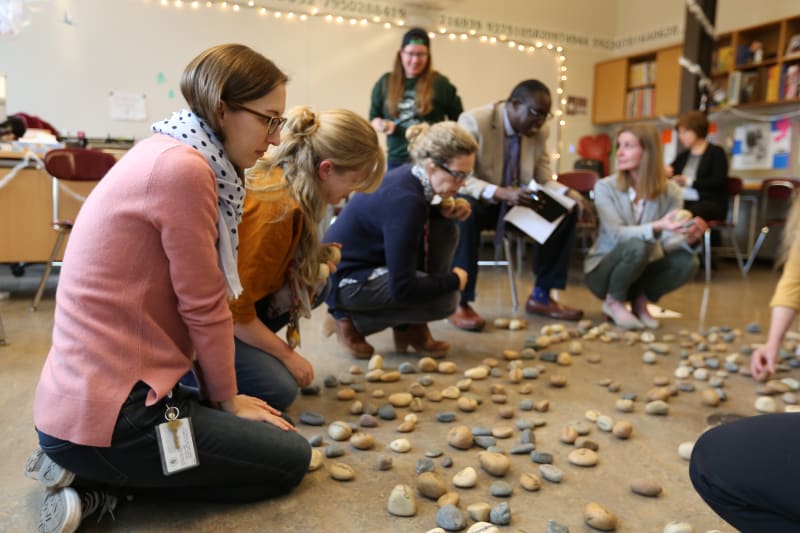
*Note: We credit Jessica Beels' installation of Weigh Your Words with inspiring this course. After Kathleen and I experienced this powerful art exhibit, we were drawn to the idea of creating an interactive experience with the Quaker Testimonies and something of the earth - seashells, rocks, branches... We eventually found that rocks were the best suited for our course. You can read more about Beels' exhibit here: http://www.jbeelsdesign.com/blog/?p=160


Text of article from Sidwell Friends School Website:

Using Weighted Words to Find a Personal Testimony

MARCH 10, 2020
Using Weighted Words to Find a Personal Testimony
“I think testimonies are one of the big tentpoles of Quakerism at a Quaker school,” Coffin said. “It’s listening to that still, small voice and looking at how you travel through this world constantly making yourself and the world a better place. As a Quaker school, there are no better tools than testimonies to teach reflection, making good choices, personal identity, and growth.”


Denise Coffin enters the pre-K classroom a little slowly. After all, she’s weighted down—literally. She’s pushing a dolly with three milk crates full of rocks in front of her.
“I’m getting ready to add another cart of rocks,” she said. “I want there to be even more rocks.”

Coffin isn’t a geology teacher; she teaches kindergarten. The rocks are part of a course—“Testimonies Rock!”—that she and preK teacher Kathleen Geier developed to open up a discussion about the concept of personal testimonies. Together, they’ve guided multiple grades of Lower School students, as well as faculty and staff, through the course over the past four years.
“A testimony is what’s either lacking in me that I have to work on, or something calling to me that I want to make stronger,” Geier said. “It comes from the inside out; you’re moved by how you should be and then the words are given to those actions.”

Geier and Coffin used the work of Paul Buckley from the Earlham School of Religion to boil down the concept of a personal testimony into five basic points: (1) a personal testimony is a calling, not a choosing; (2) it is a public act; (3) it is reflective of the shared values of a community; (4) it requires effort; and (5) it is an expression of love. The rocks, therefore, have words like “respect” and “service” written on them. If a child cannot find a word that speaks to them on the prepared rocks, Geier and Coffin have blank rocks for students to write their own words on.

“The rocks have different weights; they’re solid and they’re sturdy, and they’re part of the Earth,” Coffin said. “They’ve been around forever, a lot like our testimonies.”
The physical weight of the rocks also imparts an important lesson: Quantity does not equal quality.

“Sometimes they’re balancing them or they’re trying to hold as many as they can in their hands, which tells you something about how many testimonies you should really be working on at the same time,” Coffin says. “There’s such a thing as too many at once.”

In addition to a tactile experience, the rocks are also interactive—sometimes in surprising ways.
The teachers assigned the words to the rocks arbitrarily, but the children found meaning in these details. For example, Coffin said that a student might think the reason “fairness” is on a big rock and “kindness” and “community” are on small rocks is that “kindness” and “community” build up to “fairness.” Coffin found this exciting: “That wasn’t part of the design, but because of the physicality of it, it’s helping them think of a testimony in very different ways than we even anticipated.” 

The course begins with students arriving at their individual testimonies, but then they expand the idea to the larger community.
“We think about something we’re working on personally, and then we talk about it as a class,” Coffin said. She asks the students for ideas of testimonies that make sense to them and then asks them to figure out a way to apply the idea to the whole class.

There’s also something to be learned when students notice the rocks that they’re not attracted to.
“Sometimes the mission is to look for the ones that are pushing you away, that are almost repelling you,” Coffin said. “The ones where you’re think, ‘Oh, that is really uncomfortable for me. I can’t look at ‘patience.’”
Geier added that noticing those awkward rocks allows the children “to just wonder why.” Then they can say to themselves, “That’s telling me something about the work I need to do with patience.”
As Coffin and Geier developed the class, they learned as well.


At first, Geier said, she worried that some groups might not understand the exercise and become silly. “That’s just never happened,” she said. “I’ve learned to trust the silence and the exploration and them moving into the rocks without very much guidance.”


Wednesday, October 23, 2019

Conversation about Quakerism: Truth

This month we continued our yearlong series of conversations around Quakerism. We plan to gather each month for a conversation inspired by a topic connecting to our Quaker identity. Our conversations will be sparked by selected publications, videos, social media posts, news reports, etc.

We framed our conversation with the Quaker idea and testimony of Truth. We considered what Truth might mean in the context of teaching and learning in a Friends school using these resources:


Friends of What? (Quaker Historical Lexicon)


https://quakerlexicon.wordpress.com/tag/friends-of-truth/


Guided by an Inner Truth (QuakerSpeak, Sterling Dunn, 04/16/2015)
https://quakerspeak.com/guided-inner-truth/


Truth is Something that Happens (Quaker Earthcare Witness, Louis Cox)
https://www.quakerearthcare.org/article/truth-something-happens


Vital Friends: What Bayard Rustin's Life and Activism Can Teach Us About Finding Common Ground by Marta Rusek Friends General Council, 4/30/19

https://www.fgcquaker.org/news/vital-friends-what-bayard-rustins-life-and-activism-can-teach-us-about-finding-common-ground

https://www.afsc.org/story/bayard-rustin


Our conversation was loosely structured using the following prompts:
  • What questions does this raise for you?
  • What insights have you discovered?
  • What concerns does this raise for you?


Our reflections inspired some queries...

We are all listening to our own truth... How might that create and enrich our community? How might that cause divisions? How do we understand who has which part of the truth?

Where is the gray in not knowing the truth? Where is the joy in not knowing the truth?

Prison reform really resonates to some of us in the work we do. What role does truth play in our criminal justice system? How can we make this system better?

How do we listen for the truth?

If we agree that there is not just one truth, that everyone has a piece of the truth, that humility is an important part of truth, then how do we teach that to our children? How do we help them understand that no one has all the answers?

How do we model humility? (and trying out new ideas, growing, changing)

How do we approach building trust and breaking trust in our teaching and learning context?

Friday, October 4, 2019

Query for Parents this month...


For our gathering of parents this month, our clerks have created a query to guide the conversation. These queries will be shared with parents as they explore how they and their families interact with technology and screens.


In an increasingly digital age, how can we guide our children to make good choices about the use of technology and screen time?


How do we, as parents and teachers, join in this – modeling, learning, making choices, etc… What do our actions “teach” about what we value when it comes to technology/screens?

Wednesday, October 2, 2019

Conversations about Quakerism...

This month we began our yearlong series of conversations around Quakerism. We plan to gather each month for a conversation inspired by a topic connecting to our Quaker identity. Our conversations will be sparked by selected publications, videos, social media posts, news reports, etc.

We began with the big query of Friends Schools. We considered the why, when, how of a Quaker education using these resources:


Teaching Religion at a Friends School, Tom Hoopes, QuakerSpeak, 08/03/17


Quaker Schools / Friends Schools: Quakers in the World

http://www.quakersintheworld.org/quakers-in-action/66/-Quaker-SchoolsFriends-Schools


Quaker Schools: Strong Model Minority, Charles Austin, NewYorkTimes, 11/13/83


Quaker Education : What's Different about a Friends School? Drew Smith, Friends Council on Education, 7/26/17 


Quaker Indian Boarding Schools, Friends Journal, Paula Palmer 10/01/16

https://www.friendsjournal.org/quaker-indian-boarding-schools/


Our conversation was loosely structured using the following prompts:
  • What are you noticing/feeling/thinking?
  • What in these ideas feels familiar or expected?
  • What in these ideas feels surprising or unfamiliar?
  • What questions do you have?

Our reflections inspired some queries...

How does the multiplicity within each of us "speak" to our role in our community? Multiplicity meaning the varied ways we might identify... individuals who might be both Jewish and Christian, for example. This becomes important especially as we think about the identities of the learners in the room - we are used to the multiple identities and perspectives in the group, how about those within each of us as individuals?

How do we remember that we are "stumbling" forward? What does that mean? Why might it resonate? (Quote from Tom Hoopes, Quaker Speak)

Does the Quaker ethos in our rooms build because of the type of learners that we admit, or are the learners that we admit shaped by the Quaker ethos in the room? What might that mean for our teaching and learning practice?

Who are we today? How has the past shaped our ideas and opinions? What might people of the future feel shock or dismay to learn about our practices today? How do we examine our own leadings to let the light shine?


Thursday, January 11, 2018

Meeting for Worship for Social Justice and Action

This month we will gather for our Meeting for Worship for social justice and action.

The Meeting will begin in silence. One third grade student will share their Query (near the beginning of the meeting to give us focus). Meeting will close with a song. 

As way opens, teachers will take some time to reflect on our shared experiences at Meeting for Worship  Below are some ideas for framing a conversation and reflection (and reminders):

*What do we do to settle into the silence? Are we considerate of others in the silence? (Do we “take away” the silence from our friends?)
*How has Meeting helped us to build our LS community?
*In what ways might we see Meeting ideas or actions seeping into other areas of our lives?
*Are we mindful of our own Faith and Practice? Are we repeating messages? Are we speaking to each other (are we using names)?
*Are we giving the Meeting enough silence between messages? 
*What works for us as we try to settle ourselves into reflection?
*What do we do when we start to “unsettle”?
*How many messages should be shared during our 20 minutes? (remembering the meaningful silence that must follow each message)

Additionally, we will remind our community that this Meeting is a time to consider how we might move peacefully and actively forward in our lives.  

We will center on how Martin Luther King, Jr. let his life speak and how we can use that as inspiration as we shine our own lights.

In the news:

PUBLISHED: JANUARY 8, 2018 

"Yesterday the American Friends Service Committee (AFSC) was included on a list of 20 organizations whose staff may be denied entry to Israel because of their support for the Palestinian-led boycott, divestment, and sanctions (BDS) movement.
Motivated by Quaker belief in the worth and dignity of all people, AFSC has supported and joined in nonviolent resistance for over 100 years. We answered the call for divestment from apartheid in South Africa, and we have done the same with the call for BDS from Palestinians who have faced decades of human rights violations." 

Resources for teaching:


Justice & Human Rights


"The rule of law presents a path for nations to create a just and humane world. Our resources on human rights examine international systems of justice developed in response to mass violence, past and present. These emcompass struggles around racism, religious intolerance, national origin, gender and sexuality, and sexual expression."


Here are some other Friends who let their lives speak for social justice and action:

·         Margaret Fell and Elizabeth Fry – prison reform

·         Bayard Rustin – civil rights

·         Alice Paul – suffragist

·         Lucretia Mott and Levi Coffin– abolitionists

·         Elizabeth Blackwell – champion of women’s education

·         Edward Hicks – artist

·         John Woolman – abolitionist and native American peacemaker

·         Rufus Jones – anti-nazi activist


A wonderful and simple picture book that notes other peaceful activists is Peaceful Heroes by Jonah Winter.


Friday, March 3, 2017

Five Qualities of Testimonies


As I have researched Quaker Testimonies, the idea of personal or classroom testimonies has intrigued me. I was particularly struck by Paul Buckley's writings on the idea of the history of testimonies and the qualities that testimonies posses. 

I have distilled Paul's thinking into 5 succinct ideas which are more accessible as a teaching tool for children.

We use these as guidelines to teach our students how to discover their own personal testimony.

Paul wrote:
"I believe there are five essential characteristics that distinguish a testimony:  
First and foremost - as early Friends, Howard Brinton, and Wilmer Cooper all agree - a testimony is something we are called or led to - not something we choose to do on our own. It arises from a relationship with God. You could say it comes from “that of God” within us, not “that of us.” Contemporary Friends use a variety of terms to name this: Spirit, the Inward Light, Christ, the One, Goddess, 241.0496 B9247O 2012 The Origin of the SPICES–Paul Buckley http://www.scym.org/docs/2012keynote_paulbuckley.pdf 10 of 15 the unfolding of creation, and others. The particular words don’t matter. What is essential is that the source - the origin - is not our reason or our tradition or our personal preferences. So, for example, if I engage in peace work because it makes me look good to people I admire, it isn’t a testimony. It may well be good work, valuable work, important work, but it isn’t a testimony. 
Second, you must testify to a testimony. In other words, it has to be public behavior. Something I do within my family or among close friends is not a testimony. It may be a tradition or a habit, but it isn’t a testimony. For example, if I refer to Sunday as First Day when I’m among Quakers, but call it Sunday I’m when talking to others, isn’t a testimony. It’s just a quaint custom.  
Third, if we are to refer to something as a Quaker testimony, it should be representative of our entire community. I have a personal calling - to write about Quaker history and theology. I believe it is divinely inspired and it is certainly public behavior. It is a testimony, but it is my personal testimony, not a Quaker testimony. I believe it’s good and valuable work, but I need to distinguish it from the work we are called to do as a community. 
Fourth, a testimony is what early Friends called “a cross to the conscience.” This comes in two flavors; it’s a challenge to my own conscience - you might say it calls on me to act outside my comfort zone - and, equally important, it’s a challenge to the consciences of others." 
"Finally, a testimony flows from, and is an expression of, love - God’s love and our love."
Paul Buckley, The Origin of the SPICES 

Thursday, October 13, 2016

Rufus Jones, in Quakers in the American Colonies (1911)

“There has always been in the Society of Friends a group of persons pledged unswervingly to the ideal. To those who form this inner group compromise is under no circumstance allowable. If there comes a collision between allegiance to the ideal and the holding of public office, then the office must be deserted. If obedience to the soul's vision involves eye or hand, houses or lands or life, they must be immediately surrendered. But there has always been as well another group who have held it to be equally imperative to work out their principles of life in the complex affairs of the community and the state, where to gain an end one must yield something; where to get on one must submit to existing conditions; and where to achieve ultimate triumph one must risk his ideals to the tender mercies of a world not yet ripe for them.”

Rufus Jones

A Kindergarten Query for the beginning of the school year

Query writing: We took on a large job in kindergarten and wrote the first Query of the school year.   A query is a Quaker kind of a questio...