Showing posts with label George Fox. Show all posts

Sunday, October 12, 2025

Marigolds and Dandelions in Kindergarten


I was inspired by a visit many years ago to a Quaker school in which the classrooms were named for important and inspirational Quakers. I immediately felt the desire for my own elementary school division to do the same... 

Fast forward years later and that didn't exactly happen. However, I did do something in my own class. We became the Foxes and the Fells. (We often need to split into half groups - hence the two names.) There was double meaning in that designation. We have George Fox and Margaret Fell and we have the animal which would eventually go on to become the school mascot (fox) and the little rocky outcropping in England that Fox stood upon Firbank Fell (fell). Later, my teaching partner would add the "Fell pony" (fell) as a way to give both groups an animal. 


I loved my little Foxes and Fells. 


Fast forward many more years and the school adopted Star the Fox as the school mascot and suddenly foxes were a little too "on the nose." Additionally, we split our larger classes into smaller classes so I left the Foxes and the Fells behind with my former teaching partner and moved to a new class and the possibility for new branding...

After way too much thinking, I settled on Marigolds and Dandelions. While not immediately connecting to Quaker history, this new naming connects in a more powerful way. It describes a way of being for my young students. It names our big class testimonies in flower format.


Here is how I describe that to families and caregivers:

Marigolds and Dandelions

This year, your children will join (my teaching assistant) and me as Marigolds and Dandelions in room #107. 


Why Marigolds and Dandelions? 


Marigolds are flowers that are excellent companion plants - we grow marigolds near other plants because they help protect against harmful critters. If you plant a marigold beside another plant, that plant will likely thrive - it will grow big and strong and healthy. It is supported and protected by the bold, sunny marigold. That makes a beautiful metaphor for who we will strive to be in room #107 - people who support each other and help them thrive while we bloom. 


Dandelions are equally cheerful and also persistent and resilient. They grow through the cracks in a sidewalk, they stand in small bunches in a carefully tended green lawn (their own form of activism). They remind me of my childhood (how about you?), made into flower crowns, pulled apart gleefully, and rubbed on our chins - playful! We make wishes on dandelions once they produce their fluffy white seed heads. Those little fluffs float and fly and spread throughout our yards and communities. Another powerful metaphor for who we hope to be - sunny, resilient, joyful, and hopeful beings who will spread it around! 


Feel free to become “marigolds and dandelions” with us this year.


And that is the story of how we became Marigolds and Dandelions in kindergarten.


Do you name your class? What do you call your students?


Monday, July 21, 2025

Reflections on 1652 Country

Pendle Hill

This past June I headed to 1652 Country (once again) to see what questions might bubble up, whether any answers might be lurking, and to make new connections as I continue my journey… I have a hard time staying away.


"1652 Country" refers to an area in northwest England, specifically in Cumbria and Lancashire, associated with the early years of the Religious Society of Friends, also known as Quakers. It is the region where George Fox, experienced spiritual awakenings, tested his ideas, was challenged and punished, and gathered his first followers in 1652. 

1652 Country is a beautiful part of the United Kingdom which features narrow lanes, soaring mountains, babbling brooks, and endless flocks of Herdwick sheep. 


I traveled to this area of England with Friends Council on Education and Philadelphia Yearly Meeting as part of the Quaker Pilgrimage 2025. I have been before and I will hopefully go again. It is a powerful thing I do as an educator at a Quaker School, as a Quaker at Bethesda Friends Meeting, and as a human living this current timeline. You can read more about why this trip is so powerful to me here. In the past, this trip was made by Denise the teacher and by Denise the Quaker Education clerk at a Friends School. This time, the trip was simply made by me. That made it more than a trip, it was a true pilgrimage.


Each time I have made this trip, it has been powerful. I have filled my heart, brain, and soul with so much joy, power, love, inspiration, and learning. This was no different. Except that it was. I began this pilgrimage with so much weighing on my heart and brain after a difficult year. I put a whole lot of weight (too much?) onto what I might discover with and from my fellow travelers. What follows is a simplified account of what I received.


I gave myself some queries to guide my reflections during my journey. I’ll try to weave within some of those queries as the warp and weft of my tapestry (or embroidery;)).


What does pilgrimage mean to you? What draws you here?

A walk can be an opening. The earth beneath our feet, the clouds floating above, the “stuff” in between, perhaps the rain making us uncomfortable… I think that I must have felt nervous the first time I made this trip - not because of the actual rain. I’m just not a risk-taker. Solo traveling! 😳  It must have felt important at the time or I wouldn’t have taken the risk. I do recall that I returned fully energized as a teacher in a Quaker school with a list of teaching ideas. I seek a bit of that each time I sign up. But it’s the larger possibility of the opening that draws truly me back. 


Note: It’s tricky for me to define “opening” in words here. I know what I mean. However, for readers who need a little more, here is the Google definition: An opening is not a rational deduction but a spiritual experience where a truth is revealed. It might provide a sense of direction or a call to action.


As I travel along this journey, what am I noticing? What feels familiar? What is unexpected or surprising? What questions are bubbling up?


Colthouse Meeting House

I value the pace and pattern of this particular journey in June of 2025. Each day we travel by bus, chatting and connecting - these bus rides are simultaneously overly long and entirely essential. There are silent meetings, moments of silence, and periods of silent exhaustion (the good kind). There is a routine to our meals, toast on a little wire rack at breakfast, assembling a picnic lunch each morning, and sitting with fellow travelers to sustain ourselves with delicious food and laughter at dinner. There is the darkness of night that waits until the very last minute to fall. 


I am surprised at the learning that is offered during this particular trip. Our local guides are joyful, knowledgeable, and generous. We eat, sing, laugh, and learn. They led me to deeper understandings when I boldly thought I knew so much. A great reminder to remain open.


In what ways am I open to divine guidance, even when it challenges me?

This query is a good reminder to remain open to having my mind changed. I shouldn’t go forward with one right way in mind. There are so many possible right ways…


How am I connected to those who walked before me? In what ways do I sense the spiritual presence of others - past, present, and unseen?

Swarthmoor Hall
During one morning meeting, vocal ministry in the form of song - a beautiful voice singing into the silence - pulled me back and forth into the past and out to the future. I thought about hardships and violence that early Friends must have faced. The voice sings of determination. I think of the challenges and injustices that we are called to face / reckon with today. The voice sings of humanity and love. My heart wonders about the future. The voice sings of peace and action. I will never forget this meeting and this message. I keep this voice and this song as one of my favorite souvenirs. 


What seeds of peace am I gathering and planting as I walk cheerfully over the earth? What do I hope to grow? What unplanned growth might sprout?

This is where my path takes a turn. It’s time to make sure that I am acting on the journey. It’s not meant to be a vacation with pictures in an album. It’s a provocation…


I am a teacher. That makes me an activist. (After all, teaching is a form of political activism.) I plan to plant a new Quaker garden for and with my young learners. I’m reflecting on how to make our garden inclusive, hopeful, expansive, and full of action. I’m moved by the vocal ministry to gather songs of peace and justice. (Please send me recommendations!) I’m thinking about the ways a walk might be an opening. Should I / we be walking through the Quaker garden? What does that mean? Who pollinates the garden and how? Is there compost in a Quaker garden? What would it be? 


Brigflatts Meeting House

I’ve given myself this small big first step of re-versioning the Quaker garden in kindergarten. I’m intending for this to be the first step in my continuing journey. Stay tuned… (and send me feed-forward)


*I cannot recommend this pilgrimage strongly enough. Consider joining the 2027 Friends Council on Education (in cooperation with Philadelphia Yearly Meeting) Quaker Pilgrimage. Just do it.


Monday, January 1, 2024

Reflection on my pilgrimage to 1652 Country


The view from Pendle Hill

“Why do you make this trip?” 

Friends Council Quaker Pilgrimage: One Educator’s Reflection 

By Denise Coffin


Earlier this summer, I traveled to the north western part of England, often called 1652 Country, to learn more about the beginnings of Quakerism. I met up with a group of people who I would join on this pilgrimage, and the first thing one of my fellow pilgrims asked was, “Why do you make this trip?” 


We began by boarding a bus at the Manchester airport and heading north to a small town between lakes and mountains called Grasmere. As we drove on, the cities became smaller, the roads turned from highways to roads to narrow little lanes, lined with hedgerows and stone walls, and the landscape opened up. The green fields somehow grew greener, sheep were scattered on the hillsides, mountains became the background, the sky became bluer, and the clouds were enormous and fluffy. We left “today” behind and entered yesterday’s small villages of stone buildings and old shop fronts. This first “step” in our pilgrimage might have been a metaphor for the journey we were taking. Grasmere, apart from the hikers with telescoping walking sticks and waterproof gear, is a village back in time. We could envision early seekers going about their own journey here.


Why do I make this trip? I am drawn to the story of Quakerism. I am curious about the people who were so sure about their faith and the way to access it, at great risk to themselves. I am a teacher, and I feel called to learn about those people and the events that led up to and played a large role in this story. I make this trip so that I can take the story back and share it as a spark for my young learners and the part they’ll play in their own journeys. The trip itinerary provided us with the opportunity to do just that. 


Pendle Hill
We began by hiking Pendle Hill. I have hiked this hill before and George Fox is right in describing the walk up as “so very difficult.” To me, that’s an important detail, one that I connected with more on this year’s climb than on my past climbs. We were dropped off near a farmhouse at the base of the steep part of Pendle Hill. For Fox, the climb would have begun farther down the hill. For me, the climb began with a swift pace. The group initially climbed together with some pilgrims opting to stop at an early plateau to take in the views. The rest of us continued towards the top. 


It’s difficult to hike straight up. I found my pattern of climbing for a bit, stopping to look up at the distance I had yet to climb, and then turning around to gasp at the incredibly beautiful view! Squares of green fields outlined by tiny stone walls, dotted by tiny sheep, mountains rising and dipping, all of it surrounded by the biggest sky. I did eventually summit (last) and joined the waiting group where we took seats along a stone wall for a brief and spontaneous Meeting for Worship. How could we not?! The wind was fierce and invigorating. The sun shone. We were joyful and amazed. For George Fox, this was a tough hike. He was drawn to Pendle Hill for some reason that we may speculate about but do not know the real reason why. He tells us that reaching the top is a bit of a transformative experience. He tells us that what he needs to do next is revealed to him on Pendle Hill. I feel similarly inspired. The beauty is remarkable, and the terrain is green brush and grass, rough stone paths, and the driest, dustiest dirt. In the past, I always looked out at the view, but on this trip I also looked down as I walked. There were wild blueberries growing, and, at the advice of a fellow pilgrim, a few of us hiking together ate a handful “for our health.” Another pilgrim picked up trash on her way down. A few of us stopped just feet away from a sheep who looked up at us with the sheepiest of smiles. I held a rock in my hand and noticed that it was jagged and dusty and warm. You can feel history here. For me, Pendle Hill was magical, the best way to launch our journey. 

Brigflatts Meeting House

One of my favorite parts of this trip was visiting many local meetinghouses. At every meeting, local Quakers shared the history of their meetings, of their meetinghouses, of their members and membership. As a teacher of young children, I get to share the practice of Meeting for Worship with them and their families each year. Many grown ups believe that it must be difficult for young children to sit quietly for such a long period of time. The truth, however, is that I find the younger students much more able to sit and listen to their still small voices than the older children and than their grown ups! My kindergarteners and I have Meeting for Worship in a variety of places, and we often try to notice the character of the silence. Is it a fidgeting, moving of legs, breathing kind of silence? Is it an outside kind of silence with birds, passing cars, wind? Is it a very still silence with barely a noise at all? We reflect on what kind of silence suits the emergence of what kinds of messages. We check in with our hearts, bodies, and brains around which silence works best for each of us as we hear our inner voice (however we define that in our respective faiths) and let those messages settle in for our growth. 


Experiencing the silence of each of these meetinghouses, some new, some old, some very old, was powerful for me. At Brigflatts Meeting, the silence had already begun as we entered. The meeting room at Brigflatts Meeting is incredible. Old wooden floors, windows set in deep stone walls, wooden benches, some with cushions and some without, a second level balcony. The elder benches are on a riser between the windows and the door. Early members brought their dogs when the meetinghouse was first built in 1675, and there was a place for them to wait while their people worshiped. A table in the center stood with a beautiful vase of flowers. George Fox had come here. Everything was old, dark wood, stone, worn with time, uneven, beautiful. The silence was somehow old, too. It was impossibly still. The messages were beautiful. They were full of the joy of the large gathering of Friends. There was a connection to the troublemaking that early Quakers were known for and the need to make good trouble again for the sake of today and the future. Why do I make this trip? I make this trip because the intersection of joy and social justice and action and community are so important for and needed today. I traveled to England in order to bring that back for my own community, for my students, and for myself. So that I can reflect upon what that might look like for a group of elementary students at a Quaker school. 


Every afternoon, we gathered as we wished for afternoon tea and shared our impressions on the day’s experiences. We connected, laughed, shared, supported, asked questions, and became friends. This pilgrimage is more than a tour of Quaker history. It is the group that makes the pilgrimage as much as the places we visit; maybe more so. We stood in the churchyard in Sedbergh and heard the story of George Fox preaching to a gathered group while being encouraged to go into the church because “that is where the preaching happens.” Fox replied that “church is in the people, not the buildings.” It was perhaps a necessary belief for Quakers who did not and could not have buildings. For me, that idea was even more meaningful as my fellow pilgrims quickly became my teachers, guides, supporters, and friends. Notifications from our shared text chat group continue to pop up on my phone throughout the day as a friend shares a resource, an idea, a message, some photos. Messages that my new friends shared at Meetings, along with ideas that were talked about during our bus rides, fill my journal. We were a group of seekers. We might have each answered the question, why do you make this trip? differently, and that is what made the trip even more valuable to me.


Firbank Fell

Why do I make this trip? Our group was able to meet and hear from local Quakers at each of our stops. We heard about what life was like in that part of the world at the beginning of Quakerism from Ben Pink Dandelion and Wendy Hampton at Clitheroe Meeting. We met David Boulton, the author of a fascinating history of Quakerism at Brigflatts Meeting where a Friend shared a bit more about George Fox and the early seekers as they traipsed across the fields and headed to Firbank Fell. We heard from an amateur/expert embroiderer at Kendal Meeting where we learned of a special Quaker stitch created by Anne Wynn-Wilson for the tapestries that are on display there at the Quaker Tapestry Museum. During our visit with Lancaster Meeting, a local Quaker shared her research around the role of Quakers in the history of enslaved people and the truth about whether and how Meetings might have benefited. The ideas and history that she presented, along with her driving mission of providing reparations, became a call to action for all of us. In what other ways have Quakers participated in or benefited from such harmful practices? How can I/we repair relationships, provide reparations, and change systems that continue to reinforce these inequities and injustices? I make this trip to hear from Friends about what is being revealed to them and how they are continuing to answer these questions and take action. 


Quaker Tapestry
I am still marveling at the ways in which this trip tended my brain, body, spirit, and heart. My brain is full with stories, new friends, and action-provoking ideas. My body is stronger (and a bit wearier) from hiking, walking, and carrying my gear. My spirit is grateful for the opportunity to travel as a seeker, not completely sure of what I was looking for, but now knowing that I found so much. My heart is happy to have found a new community, to have been given the gift of this pilgrimage. I feel a renewed call to the Quaker education and identity of my school. That is why I make this trip.


Read the full story here on the Friends Council on Education website.


Wednesday, April 1, 2020

Artful Reflections


An interesting scene... before you set your ideas about what might be happening here, follow this path:

Look carefully. Slowly.
Look at the corners, the top, the bottom, the middle.
What do you notice? What items or beings do you see? 
Don't think yet about what might be happening, just notice what you see.

What does this scene remind you of?
What do you think of as you look at this painting?

What about this painting might feel unexpected?
What surprises you about this scene?

What do yo think is happening in this painting?
What questions do you have?
What do you wonder?

Take some time to reflect on these questions in writing or using art or by video recording. 

Don't rush. 
Let some silence fall between your ideas and keep looking carefully.


This painting is called Peaceable Kingdom.

It was painted by Edward Hicks.

This version lives at the National Gallery of Art in Washington, DC. You can visit it here.


Hicks was renowned as a minister - he had a much respected ability to share aloud the inner light rising from his silent reflection.

For Hicks, painting was an extra - preaching was his passion, what he believed he was born to do. He painted Peaceable Kingdom more than 62 times! Rumor says that you can see signs of his own state of mind, at the time of each version, in the facial expressions of his animals.


George Fox, founder of Quakerism wrote:
“Be patterns, be examples in all countries, places, islands, nations wherever you come; that your carriage and life may preach among all sorts of people, and to them; then you will come to walk cheerfully over the world, answering that of God in everyone; whereby in them you may be a blessing, and make the witness of God in them to bless you.” Statement of 1656, from The Works of George Fox (1831)

George Fox is getting at the idea of Letting Your Life Speak here.


How is Edward Hicks letting his life speak in this artistic work? 

How will you let your life speak?


Feel free to share your visible thinking with me at coffind@sidwell.edu. I will add them to this post. If you wish, include documentation (photos, video, writing) of your process.

For added information about testimonies:

https://www.nga.gov/collection/art-object-page.59908.html
https://www.nga.gov/collection/artist-info.1396.html
https://www.britannica.com/biography/Edward-Hicks


Types of thinking encouraged: 

  • Develop Questions
  • Connect to Prior Knowledge
  • Slow Looking
  • Practice Articulation
  • Safe Exploration of a Topic, Idea, or Object
  • Wonder about Differences or Similarities

Source:
A twist on the See Think Wonder thinking routine: https://www.smore.com/emm0s-see-familiar-surprise-wonder


Monday, March 9, 2020

Testimonies Rock! A course for personal growth

This is a wonderful article describing an interactive course around using testimonies to teach character development and growth.


https://www.sidwell.edu/about/news/news-detail/~board/homepage-news-panel/post/using-weighted-words-to-find-a-personal-testimony

Come join us for Testimonies Rock!


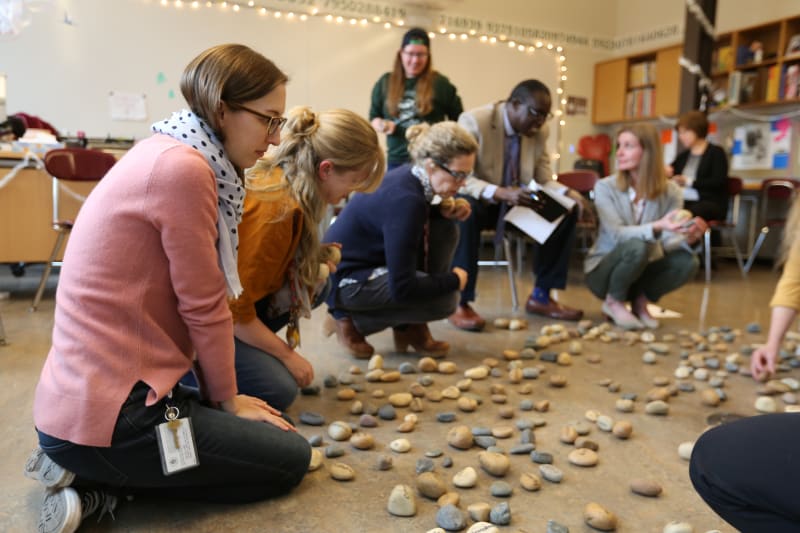
*Note: We credit Jessica Beels' installation of Weigh Your Words with inspiring this course. After Kathleen and I experienced this powerful art exhibit, we were drawn to the idea of creating an interactive experience with the Quaker Testimonies and something of the earth - seashells, rocks, branches... We eventually found that rocks were the best suited for our course. You can read more about Beels' exhibit here: http://www.jbeelsdesign.com/blog/?p=160


Text of article from Sidwell Friends School Website:

Using Weighted Words to Find a Personal Testimony

MARCH 10, 2020
Using Weighted Words to Find a Personal Testimony
“I think testimonies are one of the big tentpoles of Quakerism at a Quaker school,” Coffin said. “It’s listening to that still, small voice and looking at how you travel through this world constantly making yourself and the world a better place. As a Quaker school, there are no better tools than testimonies to teach reflection, making good choices, personal identity, and growth.”


Denise Coffin enters the pre-K classroom a little slowly. After all, she’s weighted down—literally. She’s pushing a dolly with three milk crates full of rocks in front of her.
“I’m getting ready to add another cart of rocks,” she said. “I want there to be even more rocks.”

Coffin isn’t a geology teacher; she teaches kindergarten. The rocks are part of a course—“Testimonies Rock!”—that she and preK teacher Kathleen Geier developed to open up a discussion about the concept of personal testimonies. Together, they’ve guided multiple grades of Lower School students, as well as faculty and staff, through the course over the past four years.
“A testimony is what’s either lacking in me that I have to work on, or something calling to me that I want to make stronger,” Geier said. “It comes from the inside out; you’re moved by how you should be and then the words are given to those actions.”

Geier and Coffin used the work of Paul Buckley from the Earlham School of Religion to boil down the concept of a personal testimony into five basic points: (1) a personal testimony is a calling, not a choosing; (2) it is a public act; (3) it is reflective of the shared values of a community; (4) it requires effort; and (5) it is an expression of love. The rocks, therefore, have words like “respect” and “service” written on them. If a child cannot find a word that speaks to them on the prepared rocks, Geier and Coffin have blank rocks for students to write their own words on.

“The rocks have different weights; they’re solid and they’re sturdy, and they’re part of the Earth,” Coffin said. “They’ve been around forever, a lot like our testimonies.”
The physical weight of the rocks also imparts an important lesson: Quantity does not equal quality.

“Sometimes they’re balancing them or they’re trying to hold as many as they can in their hands, which tells you something about how many testimonies you should really be working on at the same time,” Coffin says. “There’s such a thing as too many at once.”

In addition to a tactile experience, the rocks are also interactive—sometimes in surprising ways.
The teachers assigned the words to the rocks arbitrarily, but the children found meaning in these details. For example, Coffin said that a student might think the reason “fairness” is on a big rock and “kindness” and “community” are on small rocks is that “kindness” and “community” build up to “fairness.” Coffin found this exciting: “That wasn’t part of the design, but because of the physicality of it, it’s helping them think of a testimony in very different ways than we even anticipated.” 

The course begins with students arriving at their individual testimonies, but then they expand the idea to the larger community.
“We think about something we’re working on personally, and then we talk about it as a class,” Coffin said. She asks the students for ideas of testimonies that make sense to them and then asks them to figure out a way to apply the idea to the whole class.

There’s also something to be learned when students notice the rocks that they’re not attracted to.
“Sometimes the mission is to look for the ones that are pushing you away, that are almost repelling you,” Coffin said. “The ones where you’re think, ‘Oh, that is really uncomfortable for me. I can’t look at ‘patience.’”
Geier added that noticing those awkward rocks allows the children “to just wonder why.” Then they can say to themselves, “That’s telling me something about the work I need to do with patience.”
As Coffin and Geier developed the class, they learned as well.


At first, Geier said, she worried that some groups might not understand the exercise and become silly. “That’s just never happened,” she said. “I’ve learned to trust the silence and the exploration and them moving into the rocks without very much guidance.”


A Kindergarten Query for the beginning of the school year

Query writing: We took on a large job in kindergarten and wrote the first Query of the school year.   A query is a Quaker kind of a questio...