This blog contains a collection of materials, information, videos, and other ideas that I use as an educator at a Quaker school. I am currently completely preoccupied with the Quaker life and identity of the PK-4th grade at Sidwell Friends School where I also teach kindergarten.
"Quaker education seeks to nurture a particular sort of personhood ... a person who has learned that truth, beauty, goodness, and love are evidence of the transforming power of the Spirit among us; a person who regards all of life as potentially revelatory of the Spirit and everywhere imbued with meaning; a person who is optimistic about the capacity of love and goodwill to mend the affairs of humanity; a person who has begun to develop the courage to testify outwardly what he or she knows inwardly; a person who has the courage to follow the inward argument where it leads." —Samuel Caldwell, "Toward a Clearer View of Quaker Education," Friends Council on Education publication
What Samuel Caldwell describes gets at to the heart of the meaning of the phrases "let your life speak" and "lead in the Light". In these incredibly complex and quickly evolving times, there is a profound hopefulness to be found the sort of personhood a Quaker education seeks to bring forth.
At my school, we have had all manner of learning, sharing, and celebrating.
My hope for my students is that they learn to approach every new opportunity with curiosity and openness. Rather than notice differences or ideas of shock or strangeness, imagine holding space for wonder!
As a way to encourage this approach, I have created an extended thinking routine of sorts. It is our interfaith dialog and education thinking routine. We use this routine throughout the year with each new observance or tradition, each new opportunity for interfaith exploration and wonder. Teachers are free to adapt, simplify, or chunk the thinking moves in the routine in any way that makes sense for their learners. Our hope is that teachers will settle on a version that they can use again and again, making this interfaith routine, routine.
We often begin with a story. It may be a story that is read by a member of the community or the teacher. It may be a story that a member of our community shares from their own personal history or identity.
You might use this story Bringing in the New Yearby Grace Lin
In our never-ending search for ways to bring Quakerism into our classroom practices, we've got a new and simple way to visually think about testimonies!
Testimony Tulips...
In this lesson, we'll create a tulip that we'll use to explore and reflect on our personal or Quaker testimonies.
Can you draw your tulip?
What are the testimonies that you wish to explore?
How might your tulip change over time?
You might want to dive a little deeper into what a testimony by clicking here.
Types of thinking encouraged:
Develop Questions
Explore in Depth
Examine Differing Points of View
Begin to develop sensitivity to big ideas
Deepen emerging understandings about global questions/challenges
Some of Dr. Martin Luther King Jr's less familiar speeches that hold significance still today:
The Atlantic - The King Issue
Martin Luther King Jr. on the Vietnam War
editor's note: King’s opposition to the Vietnam War gained national attention on February 25, 1967, when he appeared alongside four anti-war U.S. senators at a daylong symposium in Beverly Hills, California. In a powerful address, King described how the casualties of the increasingly unpopular war had spread beyond its physical horrors to wreck the Great Society and threaten American principles and values. His outspokenness about an issue not ordinarily seen as a question of civil rights brought a storm of criticism.
Above is King's speech honoring the Preliminary Emancipation Proclamation ahead of its 100th anniversary in 1962 (this footage was rediscovered in 2013).
Video details: "On September 12, 1962, Dr. Martin Luther King, Jr. gave a speech at the Park Sheraton Hotel in New York City to honor the Preliminary Emancipation Proclamation on the eve of its centennial anniversary."
Letter from a Birmingham Jail
from the King Institute at Stanford University:
Read and listen here.
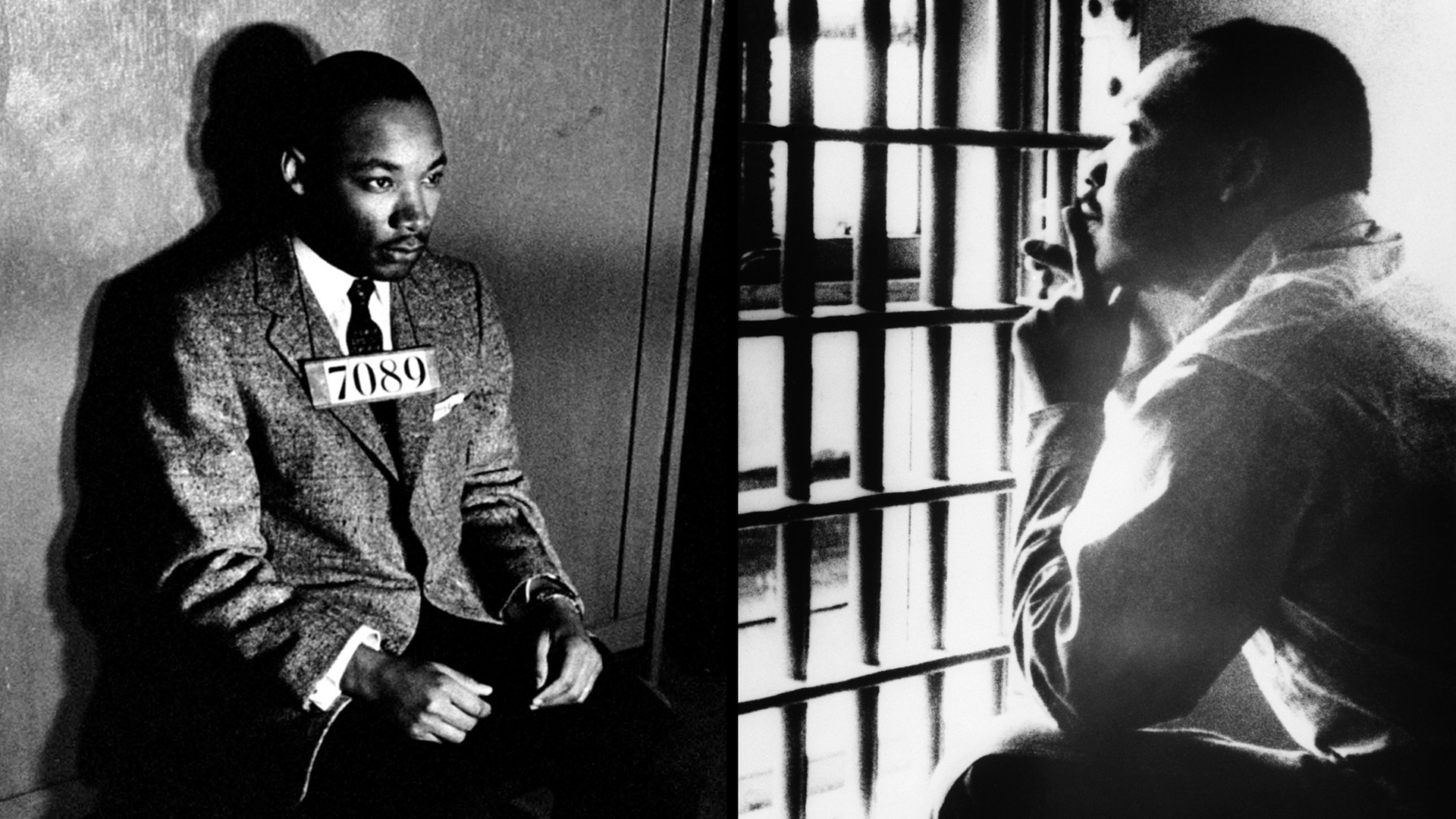
Image is shared via The Atlantic - King Issue: "King is ready for a mug shot (left) in Montgomery, Alabama, after his 1956 arrest while protesting the segregation of the city's buses. His leadership of the successful 381-day bus boycott brought him to national attention. Right: In 1967, King serves out the sentence from his arrest four years earlier in Birmingham, Alabama."
You might wish to share these resources with a protocol or thinking routine for reflection.
See What do you see or notice? Find the Familiar What about this feels familiar? What resonates? Find the Surprise What about this feels surprising or unexpected? Wonder What questions do you have? What do you wonder?
About this Routine: Use this routine to practice perspective taking and looking at things, ideas, images from a global viewpoint.
We have been challenged this year to find ways to share Meeting for Worship and other Quaker practices in a variety of ways of doing school: in person, at home, and everything in between. We have begun to document these practices for teachers, students, and other members of our community.
In this lesson, we'll learn how and why we settle or center ourselves.
How can we settle our whole selves for our community Meeting for Worship?
How can I use settling and centering outside of Meeting for Worship?
You might share this video with students and then ask them to spend some time reflecting on when it might be helpful to practice stillness.When might centering ourselves, stilling our bodies, and quieting our sounds be a handy tool?
Remember that there are many ways to worship and to be reflective. Students may practice a faith or non-faith tradition that connects with our Quaker identity along a spectrum. Find ways to celebrate and highlight those connections. Approach differences with curiosity, kindness, and openness.
We have been challenged this year to find ways to share Meeting for Worship and other Quaker practices in a variety of in person school, at home learning, and all versions in between. We have begun to document these practices for teachers, students, and other members of our community.
In this lesson, we'll set up our space.
Where will you have Meeting for Worship?
What will your Center Table look like?
You might share this video with students and then ask them to spend some time reflecting on what items might belong on their center table. Why do those selected items matter to them? How will they help them during their worship?
Remember that there are many ways to worship and to be reflective. Students may practice a faith or non-faith tradition that connects with our Quaker identity along a spectrum. Find ways to celebrate and highlight those connections. Approach differences with curiosity, kindness, and openness.